I recently sat down in a local café with a new friend, a self-described conservative voter whom I met through Braver Angels. I asked her point blank (respectfully) if she’d voted for Trump. No, she had voted for neither Trump nor Harris, both of whom she deemed “horrible” in different ways, but had she been forced to choose between the two, she’d have gone with Trump.
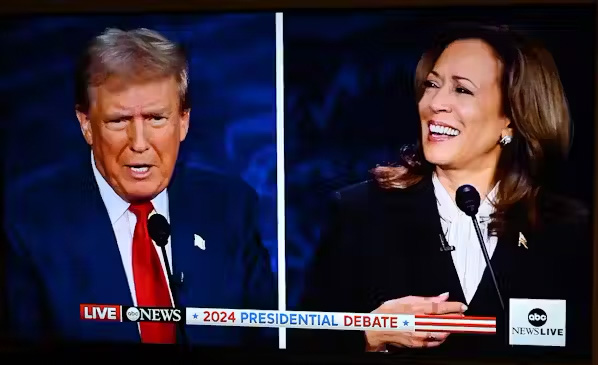
I asked her to explain what she found so awful about Harris. She spoke of the nutty and offensive “woke” culture Harris championed, and her off-putting persona. I conceded that I too was not always entirely at ease with how Harris came across, and in particular, there was a moment in her debate with Trump – a debate Harris won handily according to polls and commentators – that I reacted to with enormous discomfort.
Trump and Vance had been accusing legal Haitian immigrants in Springfield, IL of eating people’s pets – a vicious slander that had been thoroughly debunked by the mayor of Springfield and others on the scene. But in the debate, Trump doubled down vehemently on the bogus claim: “They’re eating the dogs! They’re eating the cats!” It was such an outrageous lie that the debate moderators felt compelled to step in and correct it, and of course Trump responded by calling them “biased.”
But it was Harris’s reaction that most unsettled and disappointed me in those moments. She rolled her eyes and laughed derisively, in a way that felt contrived, as if to say, “Isn’t this ridiculous? What a joke this man is!”
But of course it was no joke to the Haitian workers in Springfield, cowering in their apartments. Thanks to Trump and Vance, people had been attacking them physically on the streets. Trump’s lies were putting innocent, vulnerable human beings in harm’s way. And I wanted my candidate, Kamala Harris, to respond to this with the gravity it warranted, and with some heart, not with an eye-rolling laugh. There was absolutely nothing funny about it.
So I explained all this to my new friend, who replied, without missing a beat: “That laugh you’re talking about – that’s elitism. That is the elitism we see, that attitude.”
More Than an Attitude – A Threat
My friend sees the adoption of nonbinary gender pronouns as another form of “wokeism” and the increasingly assertive visibility of transsexual culture as an intrusive and dangerous incursion on traditional values.
“It’s like, you take this glass of water –” – she pointed to her glass – “—and now you’re saying it’s not water; it’s oil. Suddenly up is down and down is up.”
I said, “But what skin is it off someone’s nose to call somebody else a preferred pronoun? It’s like, if someone wants to change their name, but you’re not used to it. Is that really an issue?” I opined that Republican politicians were deliberately and cynically riling people up about a marginal and largely consequenceless phenomenon. I recalled a news clip of Senator Ted Cruz addressing the CPAC convention a few years ago, and he introduced himself by saying, “Hi, I’m Ted Cruz, and my pronouns are KISS MY ASS!”
“What an asshole,” was my verdict on Senator Cruz.
“But he’s speaking to some real pain that people are feeling,” my friend countered. “I have a friend whose boy came home from kindergarten asking ‘Mommy, what’s a boy? What’s a girl? What am I?’ I have another friend whose kid is continually flipping back and forth on pronouns, dress, and hairstyles … and asking about hormones.”
I thought about Trump, during the campaign, bloviating: “Your kid goes to school a boy and comes home a girl!” Of course that was typical Trump idiocy, but could there have been a grain of truth in it if a boy goes to school and comes home thinking he’s a girl?
When I was a little boy, I was occasionally called a “girl” at school. It was an insult, directed at me because I cried easily and I stank at sports, and there was no “toughness” in my persona. So now I had to wonder: If I’d grown up in an environment characterized by gender fluidity and ambiguity, might I too not have pondered the question Am I really a girl?
I can imagine that such confusion at a tender age would have been very distressing.
And yet … are people somewhere in the United States actually feeling emotionally bullied by trans people? I’ve certainly never experienced anything remotely like that. I was at a song circle recently at which I unthinkingly called an ambiguously gendered individual “brother.” Mildly mortified, I apologized immediately, and they laughed. “It’s okay!” they declared. “I’m all of it!” They could tell that I was trying to be respectful (if awkwardly so) and that was all they needed from me.
Then again, I can’t be everywhere. I don’t know what other people are experiencing. And it’s been quite a few decades since I was in elementary school.
At the table next to ours was a bright-eyed baby in a basket. I pointed out the baby to my friend because he or she (or they?) was so beautiful, and my friend said, “Yeah, see how precious that baby is, and if that baby were your own, wouldn’t you want to protect it from indoctrination? It’s a real fear people have – and for good reason.”
It was, and remains, hard for me to relate to that fear. After all, trans people have far more to fear from cis-gendered people than vice versa. But I was beginning to understand what my friend was talking about.
More than that, it didn’t really matter so much whether or not I could “relate” or understand. The point is, the fear was, and is, genuine, and it deserves respect. To dismiss another person’s fears or concerns as foolish or trivial is practically the very definition of intolerance. And of elitism.
Elitism
In the spirit of acknowledging the mistakes that “my side” has made over the years, I told my new friend quite sincerely (and I’ve said this to my leftie friends as well) that I thought Hillary Clinton’s “basket of deplorables” remark in 2016 was the single most stupid thing I ever heard a politician say in my entire life, and that it not only probably lost her the ’16 election, but also gave the right wing in this country an enduring meme.
My friend’s eyes widened a bit. “Oh, and it endures, all right. It is definitely enduring.”
And I thought about something told to me recently by another new friend – someone who, as it happens, goes by nonbinary pronouns. They told me that they had read recently that the Steve Bannons and Tucker Carlsons of our world tend to be quite welcoming and friendly to “ordinary people.” Their message to the folks they encounter is something like: “Yeah, you’re right that things suck, and your instincts are good, and it’s because of all these smarty pants liberals who think they’re better than you.”
Whereas we, the liberal counterculture so to speak (or the “woke” people as we’ve been designated) tend to be far more judgmental – even within our own ranks. Orthodoxies about what words to use and what we have to believe and be “conscious of” become more and more refined and specific, to the point where psychological landmines abound even in the “emotionally safe” spaces we work so hard to build in opposition to the mainstream culture that we deem intolerant and unenlightened.
On the one hand, such spaces arise as a response and resistance to the callous, sexist, ablest, racist, “micro-aggressive,” etc. language and behavior (and even blatant cruelty and/or violence) we perceive as pervasive in “ordinary” American culture, as amplified by Trump (and likely abetted by Putin’s social media bots).
But then, ironically, we become very unforgiving in our demands for people to be kind, “aware,” open-minded, and open-hearted. Many of us create impermeable bubbles of like-minded souls with whom to “practice vulnerability.” Amazingly, we have unwittingly made emotional transparency, and its attendant vocabulary, a badge of sophistication and elitism.

Leave a Reply